
Popular Myths from Crete You Should Know: Stunning Ancient Tales and Deities!
In this post we explore part of Cretan mythology. It includes popular and famous myths from Crete and legends related to the island.
Crete is a place where stories of gods, heroes, and mythical beings intertwine with the landscape. The ancient Greeks used these tales to explain the world around them, develop their cultural practices, and teach important moral lessons. I find it fascinating how the natural beauty of Crete, from its mountains to its caves, serves as a backdrop for these ancient stories. Take a look!
📍 Must-do: Balos Cruise 📍 Knossos Palace 📍 Check rental car rates for Crete 🚗
One of the most notable figures in Crete’s mythology is Zeus, the king of the gods, believed to have been born in the Dikteon Andron, a place also known as the Psychro Cave or Zeus Cave, on the Lasithi Plateau. His adventures, including his connection with Europa and the birth of legendary figures like Minos, have greatly influenced Cretan culture.
King Minos, who ruled the island from Knossos Palace, is famed for his ties to the Minotaur and for establishing a well-organized society with divine support. Through these myths, you can see how deeply woven the themes of protection, leadership, and the divine are in the history of Crete.
Crete Mythology
Crete’s myths that have captivated many minds through the ages. This huge Greek island serves as the backdrop for tales filled with divine beings and heroic deeds.
Crete’s mythology is vast, detailing the origins of gods, heroes, and the significance of the island in ancient Greek culture.
The myths associated with Crete, such as the tale of Zeus’s birth, highlight the island’s connection to the divine. The Dikteon Cave, is said to be the place where Rhea hid her son to protect him from Cronos.
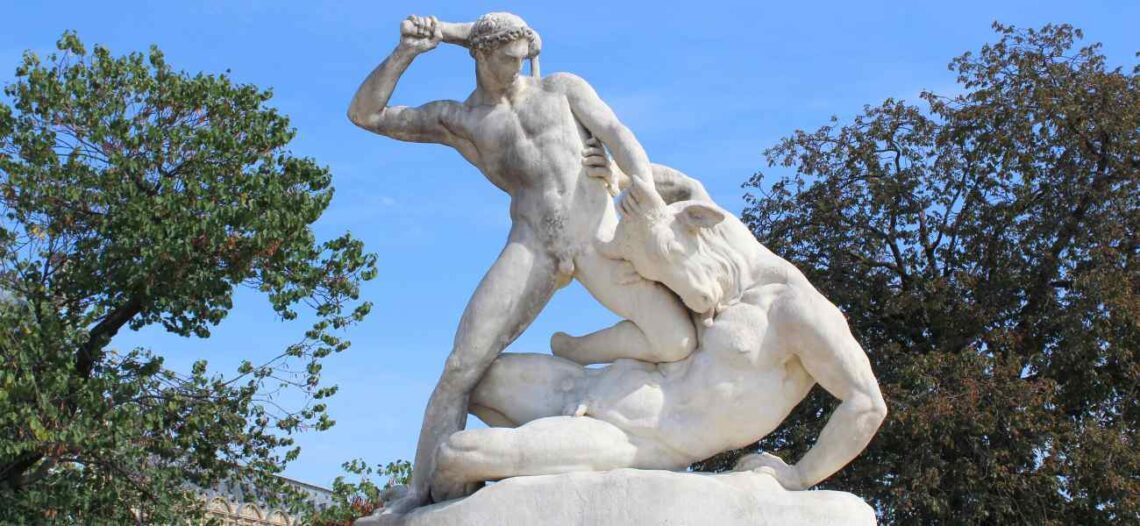
The tragic tale of a creature that was half-man and half-bull, the Minotaur also takes place on the island. According to the myth King Minos ordered the construction of an elaborate maze, known as the Labyrinth, to contain this beast. On the other hande, Theseus is a mythology hero famous for his quest to confront and defeat the Minotaur.
These stories, and many other stories, are also linked to archaeological treasures found throughout Crete, many of them exhibited in Heraklio’s Archaeoliogical Museum, and showcase the historical depth Crete has.
>> Keep in mind that myths were were orally transmitted, therefore there will always be several variations in them.

📌 Are you skimming through the post and have no time to read it now? Save it on Pinterest and read it later!
Zeus is Born: The Dikteon Andron vs. the Ideon Andron
With over Crete has 4.500 mapped caves and sinkholes, my mythos and legends are linked to such mysterious places. Two different caves in Crete are said to be the place where Zeus was born, the Dikteon Andron, in the small Psychro village, in the Lasithi Plateau, and the Ideon Andron, another impressive cave located about 20 km from Anogeia, a traditional village in Rethymnon, very close to Mount Psiloritis.
The most accepted version of this legend says that while Zeus was born in the Dikteon Cave, in Lasithi, he was actually raised in the Ideon Cave. It is believed that this was the place where Zeus and his mother hid from Cronos, father of Zeus, who wanted to kill him. Archaeologists have revealed many votive offerings in both caves, from the ancient times, like shields, spears and gold figures.
The legend says that a goat with the name Amalthea, raised Zeus in Ideon Andron by feeding him her milk while celestial warriors, known as the Curetes, protected him by clashing their weapons so as to drowned out his cries and prevent Cronos from hearing and finding him.
The Couretes (or Kouretes) were gods of the wild mountainside, related to the creation of rustic skils such as metalworking, hunting, shepherding, and beekeeping.

Zeus and Europa
One of the most important Cretan myths involves Europa, a princess from Phoenicia. According to mythology, Zeus was struck by Europa’s beauty and transformed into a white bull to approach her. The princess, charmed by the bull’s gentle nature, climbed on its back. In an instant, Zeus swam across the sea, taking her to shore near Matala in south Crete, linking the island with themes of love and divine intervention.
Once on the island, Zeus revealed his true identity to Europa. He offered her different gifts, a necklace made by Hephaestus, the bronze automaton Talos, a hound who never failed to catch his quarry, and a javelin that never missed.
Europa became the first queen of Crete and three sons were born from this union. However, after giving birth to the three children, Europa married a king Asterios.
Roman mythology adopted this tale also known as “The Abduction of Europa” substituting the god Jupiter for Zeus. The story of Europa and Zeus serves as a foundation for Crete’s significance in Greek mythology. The island symbolizes beauty, prosperity, and the favor of the gods.

Minos, Rhadamanthys and Sarpedon
From the union between Zeus and Europa, three sons were born:
- Minos, ruler of Crete;
- Rhadamanthys, often depicted as a ruler of the Cyclades but also closely related to the Phaistos Palace;
- and Sarpedon, ruler of Lycia.
Minos: Minos was the king of Knossos and considered the most ancient man known to build a navy. He reigned over Crete and lived at Knossos for nine years, consulting with Zeus to create the Cretan legislation. Good king Minos was held in esteem by the Olympian gods, and after his death he was made one of the three Judges of the Dead with his brother Rhadamanthys and half-brother Aeacus.
Rhadamanthys: On account of his inflexible integrity he was made one of the judges of the dead in the lower world, together with his half-brother Aeacus and his full-brother Minos.
Sarpedon: Sarpedon and his brothers Minos and Rhadamanthus, were adopted by the Cretan king Asterion. When they grew up, Sarpedon and Minos fought, Minos won, and Sarpedon was forced to leave, reaching Asia Minor where he ended up as the ruler of Lycia.

The Minotaur
Probably the best known myth taking place on the island is the one that sees the Minotaur as the leading character. Also known as also known as Asterion, the minotaur was a mythical creature with the head and tail of a bull and a human body. But how was he created?
After Minos was made king of Crete, he prayed god Poseidon to send him a bull to sacrifice and honor the god. However, due to the striking beauty of the animal, the kind decided to keep him instead of sacrifice him. For this deed, Poseidon decided to punish King Minos, making his wife, Pasiphae fall in love with the bull.
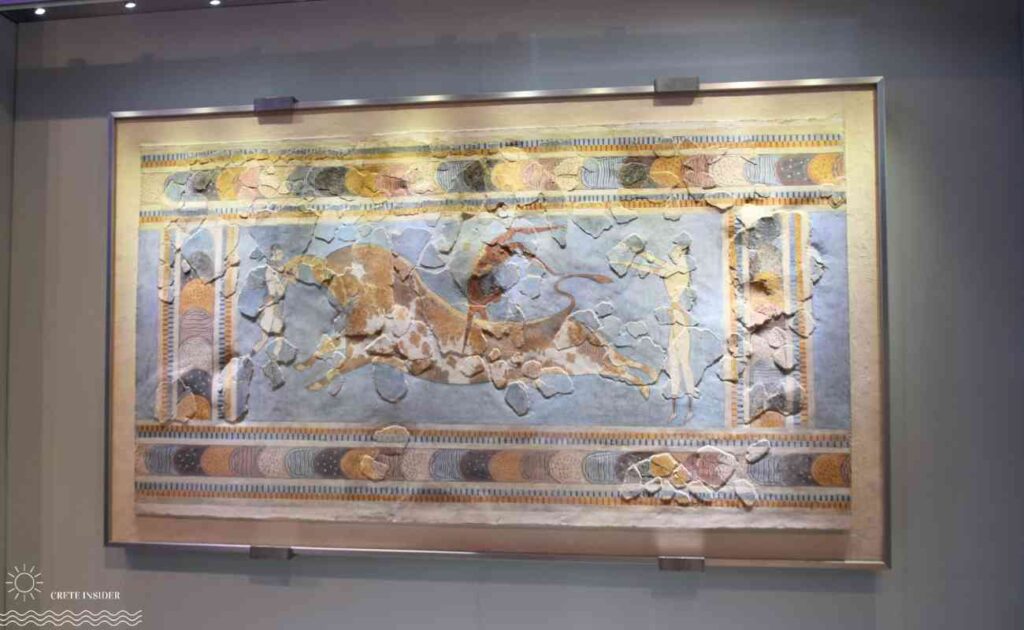
Queen Pasiphae, ordered Daedalous to build a hollow wooden cow, which she climbed into to mate with the bull, thus giving birth to the Minotaur who was a ferocious creature. For that reason, he was confined to live at the center of thr Labyrinth, an elaborate maze built by Daedalus and his son Icarus upon King Minos’ request.
The myth says that every nine years, King Minos forced the people of Athens to choose seven young men and seven young women to be offered as sacrificial victims to the Minotaur. However, tired of this cruel request, the Athenians sent brave Theseus to kill hime. The hero managed to navigate the labyrinth with the help of a thread offered to him by the King’s daughter, Ariadne.
>> You can learn more about Knossos, the Minotaur and the Labyrinth by booking this guided tour of Knossos Palace that includes a skip-the-line access to the site.

Theseus and Ariadne
Ariadne was the daughter of King Minos and Queen Pasiphae, thus also the half-sister of the Minotaur. This Cretan princess is mostly known for helping Theseus escape from the Minotaur. Although there are different variations of the myth, the most common version tells us that King Minos put her charge of the Labyrinth.
According to the myth, every 9 years, the Athenians were asked to sacrifice 7 young men and 7 maidens to the Minotaur as a compensation that Athens had to pay, because the city-state was defeated by Crete in the war.
One year, Theseus (son of king Aegeus) volunteered to be sent to Crete to kill the Minotaur. Ariadne fell in love with him and gave him a ball of thread so that he could retrace his way out of the Labyrinth after killing the Minotaur. Ariadne betrayed her father for her love for Theseus and they left Crete. However, the myth also tells us that Theseus abandoned Ariadne on Naxos where she became go Dionysus’ wife.

Daedalus and Icarus
Greek mythology tells us that Daedalus was a talented craftsman from Athens to whome King Minos requested to build a Labyrinth to keep the Minotaur. However, Minos imprisoned Daedalus and his son Icarus in the labyrinth because he believed Daedalus had given Ariadne the ball of thread that helped Theseus defeat the Minotaur.
Being a skillful artisan, Daedalus made a pair of wings for himself and for his son held to a leather frame by beeswax. However, before trying to flee Crete, he warned his son not to fly too close to the sun or the sea. Overcome by excessive arrogance – or what the Greeks called hubris – Icarus disobeyed his father soaring close to the sun where the heat melted the wax. The young man fell into the sea sanking to the bottom, giving name to the near island of Ikaria and the Ikarian Sea.

Talos
Talos is a powerful figure whose existence adds an air of strength and defense to the island’s legends. As we mentioned above, when Zeus and Europa reached Crete, he showered her with presents. One of them was Talos, a giant bronze automaton, said to have been made by Hephaestus (under Zeus’ request) to protect Europa and the island from pirates and invaders.
Acording to the myth, Talos circled the island’s shores three times each day, watching over Crete and throwing stones at ships that threatened the shores. Other interpretations of Talos’ myth suggest he had one vein, going from his neck to his ankle, bound shut by only one bronze nail.
CURIOUS FACT: In the Cretan dialect, talos was the equivalent of the Greek helios, the Sun. Besides, Zeus was worshipped as Zeus Tallaios on the island, or Solar Zeus.
Talos is deeply intertwined with Crete’s mythical narrative: the formidable guardian created by the godes, who kept the island safe from attackers, in a way he represents the divine protection that Crete enjoyed, enhancing Crete’s reputation as a sacred island.

Apollo and Artemis
The birth place of Apollo and Artemis has different versions. And even when the most famous of them refers these gods were born in the sacred Island of Delos, near Mykonos, another versions says that the god twins were born on Crete, in the nearby islets of Paximadia, on the southern coast.
Together with Zeus, Apollo and Artemis were considered protectors of Crete. In fact, two sculptures of these gods were found in the ancient ruins of Aptera, near the city of Chania, thus showing that these two gods were worshiped on the island since ancient times.

Dia Island
Another famous myth from Crete tells us that once upon a time, the island was attacked by a giant lizard. However, god Zeus came to the rescue to protect Crete and threw a lightning bolt against the threatening lizard. By duong this, he turned the beast into a stone which is now the island of Dia (which measn Zeus in Greek).

Key Characters Linked to Crete Mythology
As you can see, through these myths, the island is linked to an interesting past, playing a key roIe within the larger narrative of Greek mythology, turning crete into a symbol of myth and magic that continues to inspire curiosity.
Zeus: Often called the king of the gods, Zeus was born in Crete and spent his early years hidden from his father, Cronos.
Poseidon: The sea god, Poseidon, is closely linked to Crete. When Zeus’s son Minos asked for Poseidon’s help, the god offered Minos a splendid white bull to be sacrificed to Poseidon.
Rhea: As Zeus’s mother, Rhea played a significant role. She also entrusted him to Almathea to keep him safe from Cronos. Her connection to Crete highlights its importance in the sacred narrative of Zeus’s early life.
Amalthea: A goat (or a nympth according to a different version) who nurtured Zeus and the celestial warriors, known as the Curetes
King Minos: A a central character in Greek mythology, legendary king of Crete who expand Crete’s influence by colonizing many islands throughout the Aegean Sea. He was also believed to have been a just leader and the creator of a detailed legal system.
Theseus and Ariadne: Theseus, a valiant prince from Athens, offered himself as one of the sacrificial youths to end the brutal tradition that wanted 14 young Athenians to be sent to feed the Minotaur. Ariadne, King Minos’s daughter fell in love with Theseus and helped him overcome the Minotaur.
Daedalus and Ikarus: The skilled craftsman and inventor is credited with designing the labyrinth to contain the Minotaur. His sonIcarus, disregarding his father’s warnings, flew too close to the sun, causing his wings to melt and resulting in his tragic demise.

Crete’s mythology is a major draw for visitors. Stories of ancient gods, daring heroes, and mythical beasts create an aura of mystery that fascinates travelers who visit the island and find themselves enthralled by the legends linked to sites like the Palace of Knossos and the Dikteon Cave.
Walking in the footsteps of legendary figures while exploring these historical sites offers a unique experience, allowing you to connect with the island past.

Are you visiting Crete Soon?
Join my Facebook group for more tips, or plan your Crete itinerary with me!
Pin for Later!
Amazing Crete Myths


Gabi, the Crete Insider
Hi, I’m Gabi — your go-to local expert in Crete! I’ve been living in Chania, Crete since 2016, and I’ve turned my love for the island into a full-time passion — guiding travelers, writing for travel media, and curating local experiences.
I co-authored DK Eyewitness Top 10 Crete and other guides. I run the blogs The Tiny Book, Greece Planner, and My Cretan Recipe. Through this platform I help travelers design unforgettable trips to Crete.
→ Book your 1:1 consultation with a local to plan your Crete escape
🚘 Trusted Car Rental in Crete
CAR RENTAL IN CRETE ~ Enjoy peace of mind by hiring a car from a local company. Rethymnon Cars offers excellent cars, full insurance with no excess, no credit card deposit, and no extras.


